
MundiScope equipment review
Askar 60F
A 60 mm flat-field refractor for balanced views of nebulae and star clusters.
By MundiScope · Updated · Specifications and calculated framing
In plain English
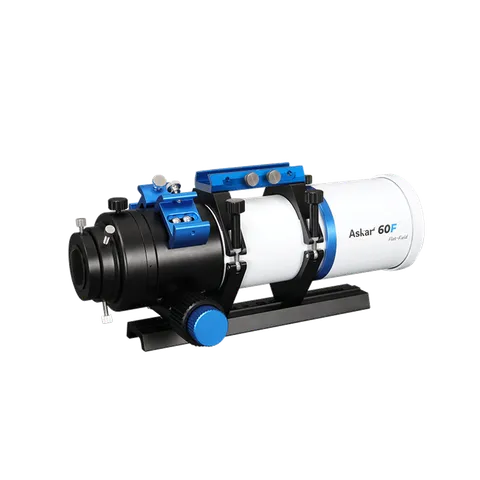
The 60F is a middle-ground option for learning remote imaging. Compared with the 50P, its longer focal length puts the same target across more pixels, but shows less surrounding sky. Four lens elements provide built-in field correction, so a separate field flattener is not needed for this configuration. Its sensor coverage is larger than the camera used for the field estimates below; that does not make the camera's own field wider.
A good choice for
Medium-size nebulae, star clusters and a closer view than the 50P, without moving to the narrowest field in the network.
What to keep in mind
The largest nebulae and galaxies may extend beyond one frame. Its modest aperture also limits fine detail on small, faint targets.
How much sky fits in an image?
With the ZWO ASI533MC Pro camera, this configuration covers approximately 1.59° × 1.59°. That is about 3.2 full-Moon widths across the frame, using half a degree as a familiar reference.
Each pixel samples about 1.90 arcseconds of sky. These are calculations from focal length and sensor geometry, not measured image quality. Cropping, atmosphere, focus and tracking affect what your final image shows.
Compare fields of view →Detailed specifications, explained
Start with the overview, then open the technical details when you want to understand the camera and optics.
Optics, camera, tracking and image scale
- Aperture
- 60 mm
The diameter of the main lens or mirror. A larger aperture collects more light and can resolve finer detail under suitable conditions.
- Focal length
- 408 mm
With the same camera, a longer focal length gives a closer view of a smaller area of sky.
- Focal ratio
- f/6.8
Focal length divided by aperture. A lower number generally records extended objects more quickly with the same camera and comparable transmission.
- Optical design
- Quadruplet air-spaced flat-field APO
Refractors use lenses; a Newtonian uses mirrors. Field correction helps keep stars better shaped away from the centre.
- Central obstruction
- 0.0% of aperture diameter
The secondary mirror blocks some light in a reflector. This percentage is a diameter ratio, not a percentage of light lost.
- Corrected image circle
- 44 mm
The image area the optics are designed to cover. It is different from the field of sky captured by the fitted sensor.
- Focuser
- Rack and pinion · 50 mm travel · 10:1 fine adjustment
Focus brings stars to their smallest size. Remote adjustment depends on the equipment fitted at the site.
- Camera
- ZWO ASI533MC Pro
A colour astronomy camera. The figures below describe its native sensor, not a guaranteed download format or processed image size.
- Sensor
- Sony IMX533CQK-C · 11.31 × 11.31 mm
Sensor size and telescope focal length together determine how much sky fits in one frame.
- Native resolution
- 3008 × 3008 pixels
The camera's native pixel grid. Cropping, binning or processing may change a delivered image's dimensions.
- Pixel size
- 3.76 μm
The physical size of one sensor pixel. Together with focal length, it determines the angular sampling below.
- Calculated field of view
- 1.59° × 1.59°
Approximate uncropped field with this camera and optical configuration. It describes the frame, not which targets are currently visible.
- Calculated image scale
- 1.90 arcsec/pixel
How much sky each pixel samples. A smaller number does not guarantee sharper detail if the atmosphere or tracking blurs the image.
- Sensor readout
- 14-bit ADC · 50,000 e− nominal full well
Readout precision and charge capacity describe the sensor. Effective dynamic range varies with the gain setting.
- Read noise
- 1–3.8 e− (manufacturer range)
Electronic noise added during readout. The value depends on the operating gain; this is not a measurement of a specific session.
- Peak quantum efficiency
- >80%
The manufacturer's peak light-to-charge conversion figure. Sensitivity varies with wavelength; it is not total system transmission.
- Mount
- ZWO AM3 · equatorial configuration
Tracks the apparent motion of the sky. Guiding, alignment and conditions affect the result of longer exposures.
- Filters & rotation
- Check the session's available controls
A filter thread or manual rotator on an optical tube does not mean a motorised filter wheel or remote rotation is installed.
- Optical transmission
- Not specified
Total light throughput has not been established here. No exposure-time guarantee is inferred from aperture alone.
This is a guide based on published specifications and calculated framing, rather than a scored laboratory test. Session controls and equipment availability are shown when you connect. Sensor specifications do not guarantee a particular capture format or output resolution.